
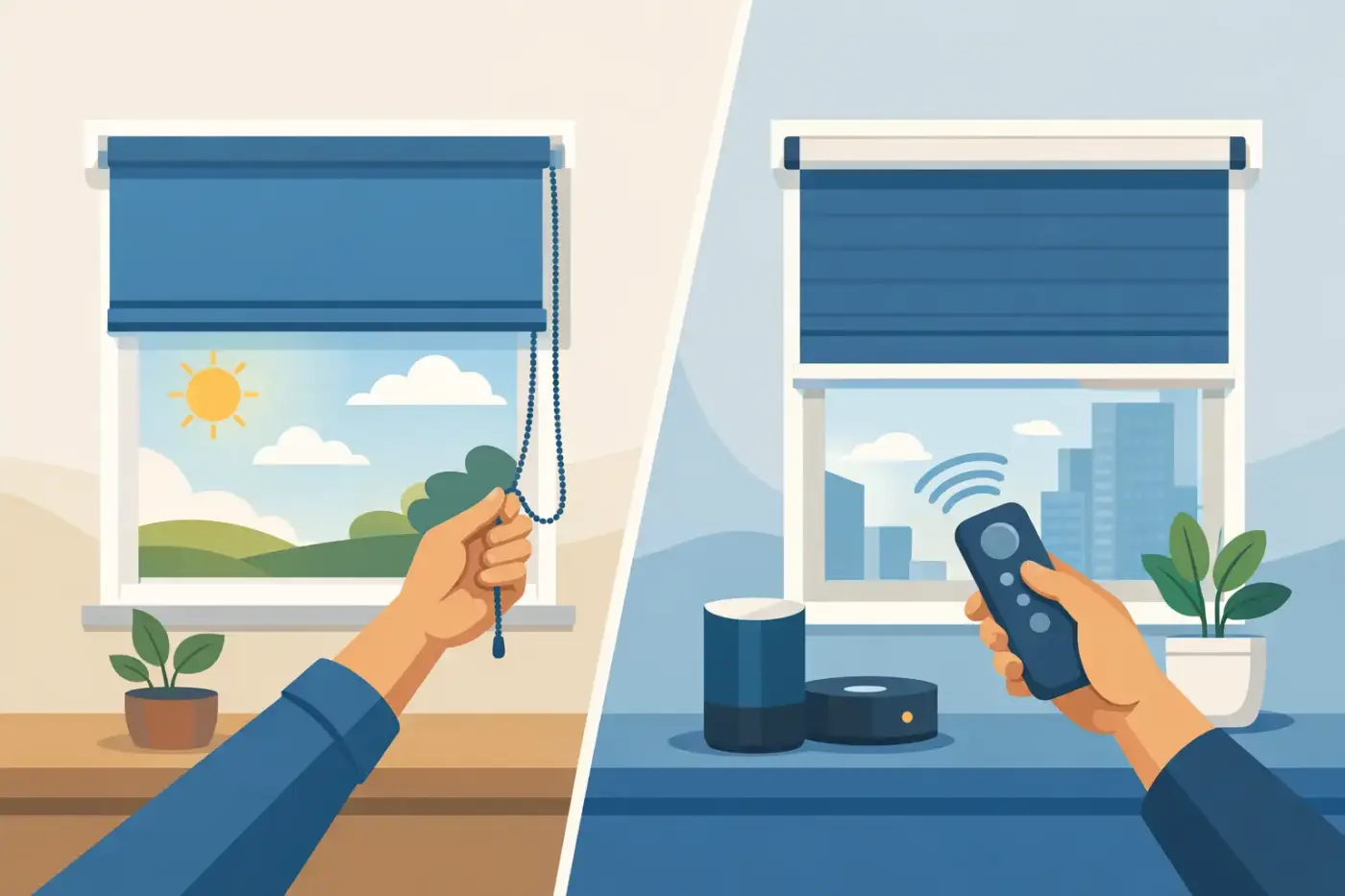
A west-facing great room can be bright and inviting at 9 a.m., then uncomfortably hot and glare-filled by late afternoon. That is why the choice between manual versus automated shades is about more than how a shade goes up or down. It affects how easily you manage Colorado sun, privacy, views, energy use, and the everyday comfort of your home.
Both options can be beautiful, durable, and custom fitted to the window. The better choice depends on the room, the window location, who uses the space, and how much convenience matters to you. For many homes, the answer is not all manual or all automated. A thoughtful mix often delivers the best value.
Manual Versus Automated Shades at a Glance
Manual shades are operated by hand, typically with a cordless lift system, continuous-loop control, or wand. They are straightforward, reliable, and well suited to windows that are easy to reach and adjusted only occasionally. A manually operated cellular shade in a guest room, for example, may provide exactly the privacy and insulation needed without adding unnecessary features.
Automated shades use a motor to raise, lower, tilt, or adjust the treatment. Depending on the product, they can be controlled by a wall-mounted control, remote, app, smart-home system, or programmed schedule. They are particularly valuable for tall windows, wide expanses of glass, hard-to-reach locations, and rooms where the sun changes dramatically throughout the day.
The visible difference may be minimal. The real distinction is how the shade works for you after installation.
When Manual Shades Are the Right Choice
Manual shades remain a smart choice for many rooms. They offer clean operation without the added cost of motors, controls, or power planning. Modern cordless designs are also a significant improvement over the corded treatments many homeowners remember, creating a simpler look and reducing loose-cord concerns.
A manual shade makes sense when the window is within easy reach and you tend to set it once in the morning and once in the evening. Bedrooms, guest rooms, smaller offices, and secondary spaces are common candidates. If a room has consistent light exposure and no need for frequent adjustment, manual operation can be practical and refined.
Manual treatments also give you a direct, tactile level of control. With a top-down/bottom-up cellular shade, for instance, you can lower the top for daylight while maintaining privacy below. With a woven shade, you can make a quick adjustment when the afternoon light shifts. There is no device to charge, no schedule to create, and no control to locate.
Cost is another consideration. The investment for manual shades is generally lower than motorized versions of the same style and fabric. That can be meaningful in a whole-home project, especially when several windows are standard size, accessible, and not exposed to harsh glare.
Still, manual operation has its limits. A beautifully designed shade does not provide much benefit if it is too difficult to reach or inconvenient to adjust. In homes with vaulted ceilings, stairwells, large windows, or furniture placed in front of glass, manual operation can become a daily frustration.
Where Automated Shades Earn Their Keep
Automated shades are often chosen for convenience, but their strongest value is consistency. They make it easier to use the window treatments you have selected, at the times when they can make the greatest difference.
In a mountain home, sunlight can be intense, especially at elevation. Automated solar shades can lower during peak exposure to reduce glare and help protect flooring, artwork, and furnishings from strong UV rays. Cellular shades can close on a winter evening to add an insulating layer at the glass. Sheer shades can adjust to soften daylight while preserving an open, welcoming feel.
That routine is easy to intend and easy to forget. Scheduled operation handles it automatically. A shade can open in the morning, lower when direct sun reaches the room, and close after sunset for privacy. For second-home owners and property investors, that predictability can be especially helpful when the home is vacant or managed from a distance.
Automation is also a practical solution for difficult windows. Consider clerestory windows, windows above a soaking tub, high transoms, floor-to-ceiling glass, or a bank of shades behind a dining table. Rather than using a pole or leaving shades in one position indefinitely, a single control can manage them comfortably.
For commercial spaces, automated treatments can create a more polished guest and employee experience. A conference room, restaurant, office, or lodging property may need glare control at specific hours without assigning someone to adjust every shade by hand.
Power Options and What They Mean for Your Project
Motorization does require a power source, but it does not always require electrical work. Battery-powered shades are a popular choice for finished homes because they can often be installed without opening walls. Rechargeable battery options can reduce the need for replacement batteries, though they still need periodic charging based on shade size, use, and product configuration.
Hardwired automation is often ideal during new construction or a major remodel. It creates a permanent power solution and can be especially appealing for large groups of shades that will be used frequently. It requires early coordination with the builder or electrician, which is why window treatment planning is best started before the final stages of construction.
Solar charging options may be available for certain products and windows. They can be useful where regular battery access would be inconvenient, although their effectiveness depends on available light and the specific application.
A professional consultation helps sort through these choices. The goal is not to add technology everywhere. It is to select a power method and control approach that feels dependable and appropriate for the home.
Light Control, Privacy, and Insulation Do Not Depend on Motorization
It is easy to assume automated shades perform better than manual ones. In truth, the shade type, fabric, opacity, fit, and installation have a greater effect on light control and energy performance than the motor itself.
A blackout roller shade can darken a bedroom whether it is operated by hand or remote. A cellular shade can help reduce heat loss at the window in either version. Solar shades can cut glare while maintaining outward visibility, and Roman shades can add softness and visual warmth regardless of their operating system.
Automation improves the likelihood that those performance benefits are used consistently. If the afternoon sun heats a room every day, programmed shades make it much easier to respond before the room becomes uncomfortable. If privacy is needed at dusk, a scheduled close can remove one more task from the evening routine.
This is why the best decision starts with the room’s needs, not the feature list. First choose the treatment that provides the right light filtering, privacy, insulation, and design. Then decide whether manual or automated operation makes the treatment easier to live with.
A Balanced Approach Often Makes the Most Sense
A whole-house motorization plan can be wonderful, but it is not the only well-designed solution. Many homeowners choose automation strategically: high windows in the great room, a sun-exposed primary bedroom, a media room, or large sliding doors receive motorized shades, while accessible guest rooms and less frequently used spaces remain manual.
This approach directs the investment toward the windows that create the most day-to-day challenges. It also keeps operation consistent where it matters most. A great room with multiple shades can be controlled as one scene, while a manually operated shade in a guest bath remains simple and cost-conscious.
Design continuity does not have to suffer. Manual and automated versions of the same shade style can often share the same fabric, color, valance, and overall appearance. Visitors see a cohesive window-treatment plan, while you get the right level of convenience in each room.
Questions to Ask Before Choosing
Start by thinking about how you use each room, rather than asking whether automation is generally worth it. Are the windows easy to reach? Do you regularly adjust them for sun or privacy? Does the room get strong morning or afternoon exposure? Will furniture make access difficult? Is this a primary residence, second home, rental, or business setting?
Also consider the timing of your project. If you are building or remodeling, discussing automated shade locations early can preserve hardwired options and keep controls coordinated with lighting and smart-home planning. If your home is complete, battery-powered motorization may offer a clean, flexible alternative.
Finally, see the materials in the actual space. Fabric openness, color, texture, and opacity can look very different under bright mountain light than they do in a showroom or on a screen. Measurements, window depth, trim details, and how several treatments relate across an open floor plan all matter.
At Ben’s Blinds, an in-home consultation is designed to make those decisions feel manageable. Looking at the windows together makes it easier to identify where manual shades are a perfect fit, where automation will genuinely improve daily life, and how the finished design can feel intentional throughout the home.
The right shade should not ask you to change your routine to accommodate it. Choose the operation that makes comfort, privacy, and light control feel natural in the way you actually live.
No responses yet